
It's Adaptive, Stupid

Updated: Jul 14
Luciano Floridi writes in The Ethics of Artificial Intelligence that, as AI becomes better at solving problems, human intelligence will increasingly be about deciding “which problems are worth solving, why, for what purpose, and at what acceptable costs and trade-offs".
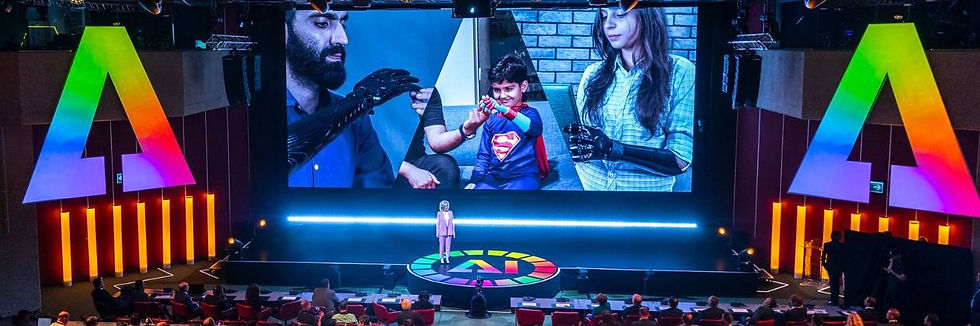
Geneva, Switzerland.- The AI for Good Global Summit 2026 emphasized a distinct message: artificial intelligence is swiftly evolving into the foundation of a new economic structure.

Discussions ranged from sovereign AI initiatives and national digital infrastructure to ambitious scientific projects such as GeoGPT, a multimodal foundation model for analyzing Earth systems. Some presenters suggested that these models could eventually uncover common informational patterns across biological systems, perhaps even a “universal biological language,” a compelling hypothesis.
While governance remained a central theme, what stood out most was the growing emphasis on organizational trust, human agency, and designing safe, accountable AI by design.
According to the International Monetary Fund (IMF), approximately 40% of jobs worldwide are exposed to AI, rising to nearly 60% in advanced economies. These numbers alone should reshape how universities, businesses, governments, and citizens prepare for the future.
What is deeply concerning is the governance vacuum emerging around AI. Governments point the finger at Silicon Valley, while Silicon Valley points back at regulators. Meanwhile, the technology continues advancing at an exponential and unprecedented pace.

The greatest challenge is no longer primarily technical, it is adaptive. But if I had to quantify it, I would argue the challenge is 80% adaptive and 20% technical. As Iceland’s President Halla Tómasdóttir reminded the audience in Geneva, "AI may evolve at exponential speed, but trust is earned through human choices, institutions, and values, not algorithms."
It's Adaptive Stupid. Our success as a civilization will depend less on building more powerful models than on rethinking ethics, leadership, and cristal box accountability in what is rapidly becoming a token-based economy.

AI compliance, safety, and governance must be embedded by design, not added as an afterthought. Independent third-party algorithmic audits and certification will become equally essential to building trustworthy AI ecosystems. Trust cannot be improvised.
This conversation cannot remain confined to engineers, researchers, or policymakers. As Yuval Noah Harari has argued, humanity has often struggled with governing transformative technologies while still relying on what he has described as “very primitive technology” our current social media landscape. The governance challenge is therefore not merely technological; it is profoundly societal.
Every leader, policymaker, educator, business executive, parent, and citizen has a role in shaping the future of AI. Like previous global challenges, including protecting the ozone layer and confronting climate change, this moment demands collective action rather than isolated responsibility.
We must take ownership of our future. Doing so requires a profound shift in mindset, stronger moral agency, effective governance, greater accountability, and ultimately a new social contract for living alongside algorithms.
AI has already transformed work, education, healthcare, business, and democracy. No one will remain untouched. The greatest challenge ahead is to become more aware, better educated, and better informed about both the risks and opportunities of AI. This responsibility begins at home, continues in our schools and universities, extends into boardrooms and governments, and ultimately belongs to every society. Humanity itself must now evolve to meet this new reality.

I leave Geneva inspired, but also convinced that the next chapter of AI leadership will not be defined by technological breakthroughs alone. It will be defined by our ability to preserve and elevate the human experience. Our classrooms, institutions, and cultures must remain places where judgment, creativity, empathy, and wisdom continue to flourish for the benefit of future generations.
Humankind has repeatedly demonstrated an extraordinary capacity to adapt. That instinct is embedded in our DNA. The question is whether we can adapt wisely enough to ensure that technological progress strengthens, rather than diminishes, what makes us human.
One question stayed with me throughout the Summit, What are we losing as AI becomes more intelligent and more capable? The answer I heard most often was both simple and unsettling: The current boundaries of human expression.

On a final note, concerning the original question posed in this article: any insights so far?
Would you choose to upload your entire life to a digital network? Not just your photos or your memories, but your voice, your thoughts, your work ethic, your values, your mistakes, your doubts, and your deepest moral dilemmas.
Would you consent to preserving the essence of who you are so that generations yet unborn, your descendants centuries from now, could dialog with you, and understand the person you once were? If technology made it possible, would you embrace digital immortality or would you choose to remain exclusively human? Give it a thought.


Comments